Specifications checked against Evenflo’s US site and manual on . Not hands-on tested. How I research
Who is the Maestro Sport Booster Car Seat for?
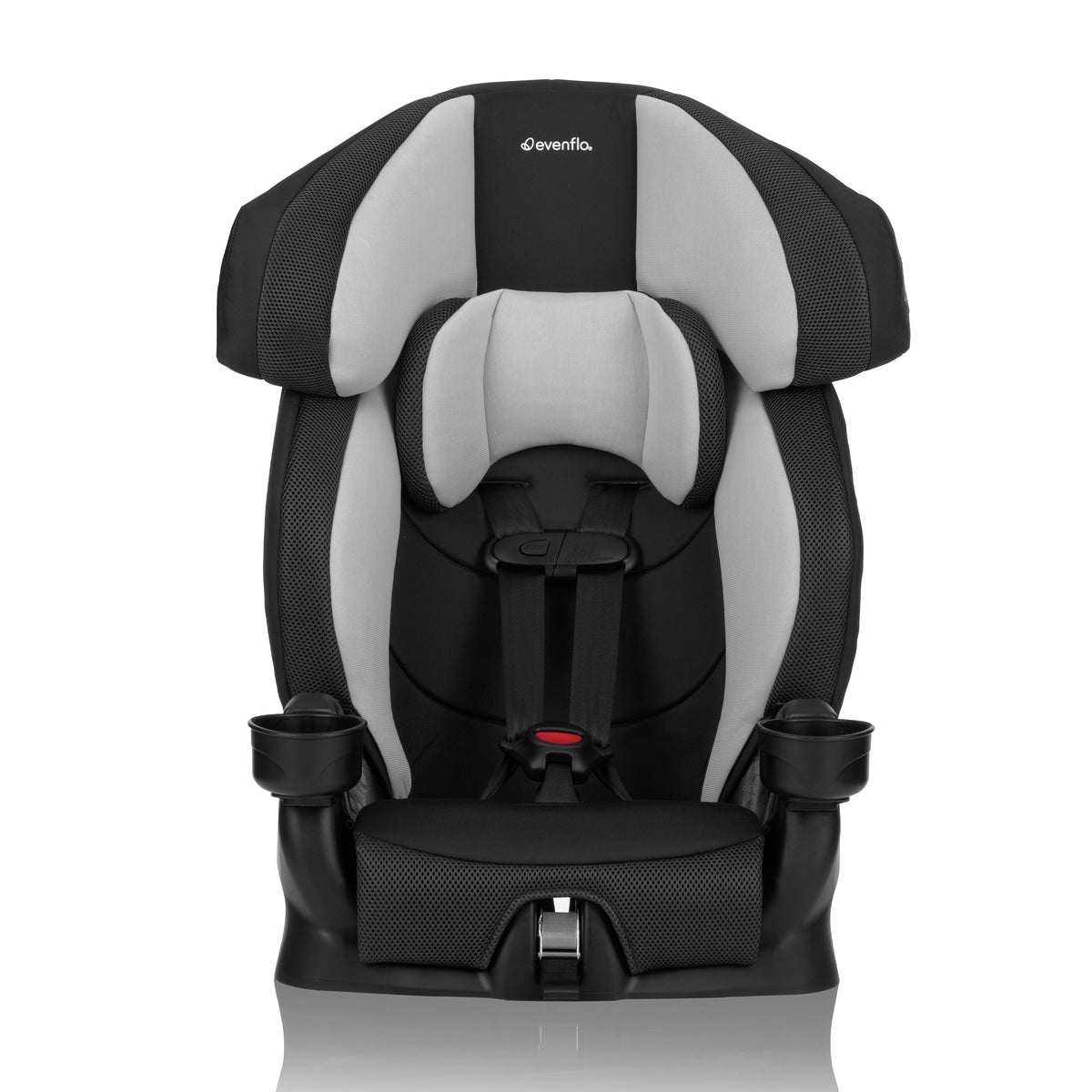
The Maestro Sport is a forward-facing harnessed booster. The manual allows the 5-point harness from 30 to 50 lb and 35 to 49 in for children at least 2 years old, then a high-back booster from 40 to 100 lb and 44 to 57 in for children at least 5. Evenflo lists it at 9.6 lb and 19 in wide.
Reasons to consider it
A 5-point harness to 50 lb and 49 in
Listed at 19 in wide and 9.6 lb
Certified for aircraft when used with the harness
Up-front harness adjustment and a RightFit belt path for booster mode
Things to weigh up
The buckle strap must move to the front slot once the child reaches 40 lb
Not certified for aircraft in booster mode
The product page lists 22 to 110 lb overall and a minimum age of 5 Years, which do not match the manual's harness limits
No expiration period in years is published
My take on the Maestro Sport Booster Car Seat
It suits a family that wants the harness to last past 40 lb in a narrower shell. The trade-off is that it is forward-facing only and has no backless mode, and the booster stops at 100 lb. Evenflo lists the Chase LX with a harness to 40 lb and a width of 21.9 in, while the Maestro Sport harness runs to 50 lb and the seat is listed at 19 in wide.
A research summary of Evenflo’s published specifications and manual, read . Not a hands-on test or a crash-safety rating.
Who the Maestro Sport Booster Car Seat fits
This seat covers 2 stages, and a child has to meet every limit of the stage they are in. Check the date label on the shell before using a hand-me-down; every seat has an expiry.
Forward-facing harness30 to 50 lb · 35 to 49 in · from 2 years
The child faces forward in the seat’s own harness. Use the top tether every time, and stay in the harness until the child outgrows it.
High-back booster40 to 100 lb · 44 to 57 in · from 5 years
The seat’s own back and belt guide route the vehicle belt across the shoulder, and the sides give the child something to lean on when they sleep.
What are the Maestro Sport Booster Car Seat weight, height and age limits?
Evenflo Maestro Sport Booster Car Seat limits by mode
Mode
Child weight
Child height
Minimum age
Conditions
Forward-facing harness
30 to 50 lb
35 to 49 in
2 years
At least 2 years old; ears at or below top of headrest.
High-back booster
40 to 100 lb
44 to 57 in
5 years
At least 5 years old.
A child must meet every limit for the mode they use. The labels on your seat and its manual are the final word.
Maestro Sport Booster Car Seat specifications
Seat weight
9.6 lb
Width
19 in
Depth
17 in
Height
27.5 in
Usable life
See the date label on the seat
Aircraft use
Certified for aircraftManual: certified for aircraft in harness mode; NOT certified for aircraft use in booster mode.
How the Maestro Sport Booster Car Seat installs
Harness
Up-front harness adjust. Check the harness height at each growth spurt: at or below the shoulders rear-facing, at or above them forward-facing.
Every install is a fit between one seat and one vehicle. Read both manuals, and use a free inspection station if anything is unclear.
Will it fit your car?
At 19 in at its widest, measure your back seat before counting on three across. It weighs 9.6 lb, which matters if you will move it between cars or carry it through an airport.
Check your vehicle manual for lower anchor positions and any head-restraint rules.
Rear-facing seats need front-seat room: try the install behind the driver before you commit.
Certified for aircraft use, so it can travel as a seat rather than checked baggage.
What features does the Maestro Sport Booster Car Seat have?
Up-front harness adjust
Dual cup holders
RightFit belt path
Colors listed in the US
Crestone Peaks Gray, Granite Gray, Aspen Skies Gray, Whitney Purple.
Maestro Sport Booster Car Seat colors and prices
2 colors are listed on Amazon right now. Every color is the same price today. The fabric is the only difference between them; the shell, harness and limits are identical. Prices were retrieved Nov 2, 9:51 PM UTC and can change.
Compare Maestro Sport Booster Car Seat colors side by side
Prices and availability shown are accurate as of the time indicated and are subject to change. Any price and availability information displayed on Amazon.com at the time of purchase will apply. As an Amazon Associate I earn from qualifying purchases.
Where Evenflo’s page and manual disagree
Recorded from manual.
Outlet listing appears to describe an earlier version.
When they differ, follow the manual and the labels on your seat.
What to know before you live with it
Installing with the harness
Install the seat forward-facing with the lower anchors or the vehicle belt through the belt path, and attach the tether. The manual says not to use the lower anchors with a child over 50 lb in the internal harness, which matches the harness limit. If the tether does not reach the vehicle anchor, ParentLink supplies a tether extender. The seat must not move more than 1 in side to side or front to back. Do not use it with lap belts that lock only in a crash, door-mounted belts, or belts that sit forward of the seat crease.
The straps sit at shoulder level or slightly above. To move them you release the harness, take the straps off the splitter plate and feed them through the new slot in both the pad and shell. The chest clip goes at armpit level. The buckle strap goes in the slot closest to the child, never under the bottom, and the manual requires the front slot once the child weighs 40 lb or more. The harness stage ends at 50 lb, 49 in, or when the shoulders pass the highest harness level. A child under 5 at that point must leave the seat.
In booster mode the child must be 40 to 100 lb, 44 to 57 in and at least 5, with the ear tops at or below the top of the headrest. Use only a lap and shoulder belt, and do not use a locking clip in booster mode. The shoulder belt runs under the headrest while the shoulders are at or below the opening between headrest and shell, and over the headrest once that would pull the belt behind the shoulder. If the vehicle has LATCH, you may attach the booster with it so the empty seat is held in a crash.
To take the pad off, disconnect the harness straps from the splitter plate, release the elastic loops and two retaining strips, then pull the headrest pad off and take out its foam. Machine wash the seat pad separately in cold water on a delicate cycle and tumble dry 10 to 15 minutes on low heat. The manual says to always put the foam inserts back before refitting the pad, and never to use the seat without it. The harness is wiped with mild soap and water, and 70% isopropyl alcohol may be used to disinfect.
25C003000: does not cover this model. The Part 573 report covers only Canadian-market seats and travel systems with listed model numbers ending in C (for example 34912258C, 38412311C, 3811198C, 35012433C), listed with production dates January 1, 2018 to December 31, 2024 and shipped to US buyers without a US registration card; the population is defined by those numbers. This product's US model numbers CS500311921, CS500312203, CS500312204 and CS500312258 are not listed; only the Canadian Maestro Sport 34912200C and 34912258C are. Campaign source (read ).
14C003000: does not cover this model. The Part 573 report covers 2011 to 2014 convertible and harnessed seats with model number prefixes 306, 308, 310, 329, 345, 346, 371 and 385, with affected manufacture dates ending no later than March 3, 2014, the last production date using the subject buckle. The Maestro Sport (CS500311921, CS500312203, CS500312204, CS500312258) does not carry the listed 310 Maestro prefix. Campaign source (read ).
10C005000: does not cover this model. The Part 573 notice covers only Maestro seats with model numbers beginning 310 (3101198, 3101980, 31011048, 31011049, 31011059) built November 24, 2009 to April 9, 2010. The Maestro Sport (CS500311921, CS500312203, CS500312204, CS500312258) has different model numbers, and the notice states that units built after April 2010 are not affected. Campaign source (read ).
Each campaign naming this family was read against this model’s numbers and build dates, and none covers it. Still check your seat’s model number and date of manufacture before use, especially on a used seat.
How is the Maestro Sport different from the Chase Plus?
Evenflo lists the Chase Plus with a 30 - 40 lb harness, 21.9 in width and 9.5 lb weight. The Maestro Sport harness goes to 50 lb, and the seat is listed at 19 in wide.
The manual does not give a number of years. It refers to the expiration date on the date of manufacture label and says to stop using the seat after it or after a crash.
Answers refer to the model and manual version on this page. Check the instructions supplied with your seat.
Before you buy
Weigh and measure your child. The limits above are the manufacturer’s, and a child has to meet all of them for the mode they will use.
Confirm the exact version. Colors, retail exclusives and model numbers change limits more often than you would expect; Evenflo lists 4 colors of this seat.
Read the manual before you buy, not after. It is linked above and holds the fit rules, the install methods and the expiry.
Check recalls by model number and date of manufacture, and register the seat with Evenflo so you hear about the next one.